



Like Hindus, there is significant casteism among Indian Muslims, but the secular political parties of India have always kept this fact hidden and never allowed it to become a political issue for their electoral benefit.
However, we will expose it.
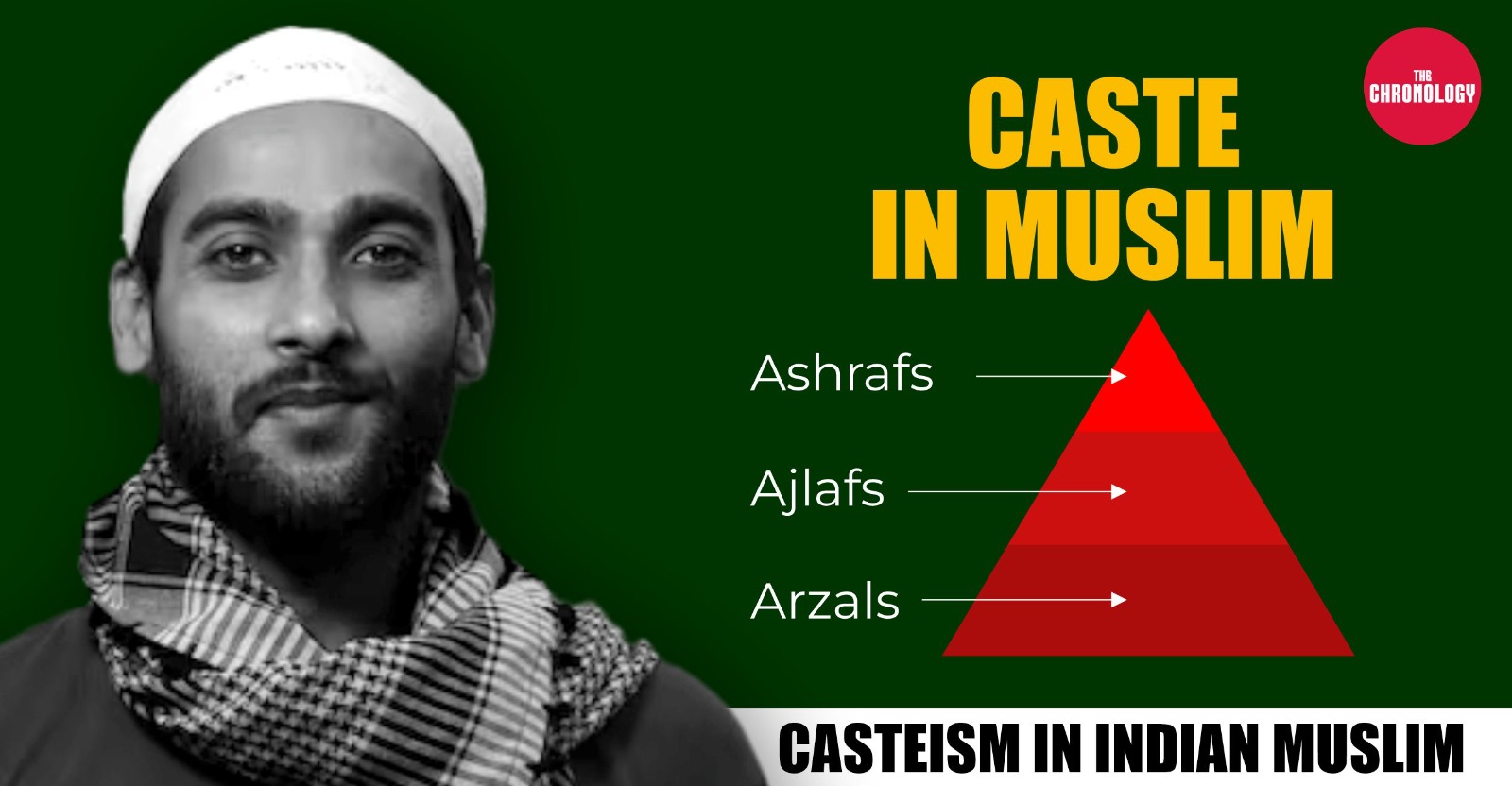
Like Hindus, Muslims also have three classes:
- Ashraf – Upper caste (Comparable to Savarna)
- Ajlaf – (Comparable to OBC)
- Arzal – (Comparable to SC)
Ajlaf + Arzal = Pasmanda Muslims
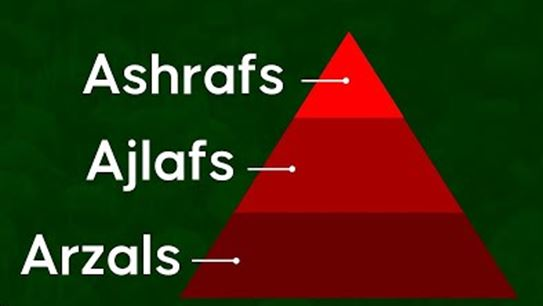
- Ashraf (15% of total Indian Muslims)
They are considered the “real” Muslims and occupy the topmost position in the Muslim hierarchy. They trace their ancestry to outsiders and are believed to have the “true” bloodline of Muslims. Groups like Sayyeds, Mirzas, Sheikhs, and Pathans fall into this category. Sayyeds are considered descendants of Prophet Muhammad.
- Ajlaf
Ajlaf Muslims can be compared to Indian OBCs. They are not considered “real” Muslims by the Ashraf. These are Savarna or OBC Hindus who converted to Islam, including groups like Qureshi, Fakir, Ansari, Mansoor, Rayeen, Julaha, etc.
Ajlafs also have upper and lower sub-categories. They are entitled to reservation under the OBC category in India.
- Arzal
Arzals are the most inferior group among Muslims. These are Dalits who converted to Islam, hoping for equality, but never fully received it. Groups like Razzak and Halalkhor belong here.
They are equivalent to Dalits in Hindu society.
Ajlaf and Arzal together are referred to as Pasmanda, making up 85% of the total Indian Muslim population. Essentially, they are converted Hindus.
Hinduism, to a significant extent, has reduced caste-based discrimination due to education, reservations, the SC/ST Act, and modernization.
However, in Islam, due to the absence of reservations, educational support, and laws like the SC/ST Act, casteism is arguably more prevalent among Muslims than among Hindus.
For instance, Muslims have separate graveyards (kabrastans) based on caste. In earlier times, and even today in some places, Ashrafs sit in front in mosques, reflecting caste-based hierarchy.
Marriage also remains deeply influenced by caste.
Key Difference Between Hindu and Muslim Casteism:
In Muslim society, casteism is largely a social issue, while in Hindu society, casteism has become more of a political issue. Much of this can be attributed to India’s secular parties, especially the Congress party and the global left ecosystem.
Congress made casteism in Hinduism a political issue to divide Hindus, but they never highlighted casteism in Islam, ensuring that the Muslim vote bank remained united.
They have labeled Hinduism as problematic due to casteism but have never similarly criticized Islam. They discredited the Brahmanical system in Hinduism but supported the Ashraf-dominated system in Islam.
The reason for this was political. By controlling the Ashraf class, they could easily influence the entire Muslim community.
The Congress ecosystem has always promoted the Ashraf system, and leftist academics and foreign researchers have largely avoided touching on the issue of caste in Islam.
Data doesn’t lie:
Out of 7,500 elected representatives from the first to the fourteenth Lok Sabha, 400 were Muslims. Out of these 400, 340 were from the Ashraf (upper caste) community. Only 60 Muslims from the Pasmanda background have been elected to the Lok Sabha in all these years.
So, the 15% Ashraf population has been taking 85% of the benefits meant for Muslims, but leaders like Rahul Gandhi never speak about this.
The Congress party’s strategy was clear: unite Muslims on the basis of religion and divide Hindus on the basis of caste.
In the pursuit of electoral victories, Congress and its allied parties have damaged a 10,000-year-old civilization.